
Home/
Great Strategic Rivalries
Great Strategic Rivalries
No customer reviews yet
ISBN 9780190620462
Oxford University Press, USA
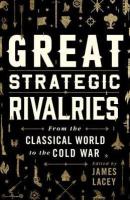
From the legendary antagonism between Athens and Sparta during the Peloponnesian War to the Napoleonic Wars and the two World Wars of the twentieth century, the past is littered with long-term strategic rivalries. History tells us that such enduring rivalries can end in one of three ways: a series of exhausting conflicts in which one side eventually prevails, as in the case of the Punic Wars between ancient Rome and Carthage, a peaceful and hopefully orderly transition, like the rivalry between Great Britain and the United States at the turn of the twentieth century, or a one-sided collapse, such as the conclusion of the Cold War with the fall of the Soviet Union. However, in spite of a wealth of historical examples, the future of state rivalries remains a matter of conjecture.
Great Strategic Rivalries explores the causes and implications of past strategic rivalries, revealing lessons for the current geopolitical landscape. Each chapter offers an accessible narrative of a historically significant rivalry, comprehensively covering the political, diplomatic, economic, and military dimensions of its history. Featuring original essays by world-class historians--including Barry Strauss, Geoffrey Parker, Williamson Murray, and Geoffrey Wawro--this collection provides an in-depth look at how interstate relations develop into often violent rivalries and how these are ultimately resolved. Much more than an engaging history, Great Strategic Rivalries contains valuable insight into current conflicts around the globe for policymakers and policy watchers alike.
"[A] forceful look at many of the notable rivalries of history....Among the strengths of the work overall is that the chapters, whose topics are distinct and can be read independently, nonetheless allow a reader to encounter both thematic patterns between rivalries and complementary vantage points of different powers' strategic positions....Great Strategic Rivalries usefully examines over two millennia of military history in an informative and useful way....[A]n effective work that is well organized and expertly written, and the result is a worthwhile resource."--Nicholas Michael Sambaluk, Journal of Military History
"An excellent introductory chapter and sixteen valuable essays on the great international struggles of history, from the contest between Athens and Sparta to that between the Cold War superpowers. Each one can be read--and will be greatly used by students and professors alike--as a stand-alone survey. It's a great addition."--Paul Kennedy, Yale University
"From the conflict between Athens and Sparta which ravaged ancient Greece, to the Cold War which dominated the 20th century, humanity has been plagued by these collisions. Here this phenomenon, the great strategic rivalries which have inflicted such sufferings on mankind, is considered in its own right. James Lacey has brought together a series of forensic dissections of the causes and effects of these terrible events across world history. Every chapter is written by an expert of international repute who describes and analyses the course of events. The result is much more than an antiquarian look at the past, for we now face fresh uncertainties as new rivalries emerge in our uncertain world. Those who write here scorn simplicities and slogans, and instead offer insight into the complexity of human affairs at the highest level, for 'Those who don't know history are doomed to repeat it.'"--John France, Swansea University
"This impressive collection of essays is the first serious historical investigation of enduring strategic rivalries as a structural feature of inter-state conflicts. The case studies range from Athens and Sparta's clash in the Peloponnesian War to US-Soviet rivalry during the Cold War, and cover not only the motivations behind such enmities, but the broader conditions which call them forth and bring them to an often abrupt conclusion."--Peter Wilson, All Souls College, University of Oxford
"Kudos to James Lacey who has assembled preeminent military historians to explain the strategic rivalries of great powers from the Greeks to the Cold War. What emerges is a superb reminder that human nature over the ages does not change and nations remain governed as much by their collective emotions as by their rational calculations. The result is a professional and refreshing effort to remind us that behind the fog of war there are always strategies, whether foolish or inspired." --Victor Davis Hanson, Stanford University, author of Carnage and Culture
About the author
Product details
BrandOxford University Press, USA
Pub dateNov 9, 2016
ISBN-100190620463
ISBN-139780190620462
Pages680
Dimensions9.5 × 6.3 × 1.7 in
Weight2 lb
Last updated 2021-02-16 14:00
$54.47
$67.00
18% off
You save $12.53 · list price $67.00
In stock — ships in 24 hours with free tracking
Delivery by Wednesday, September 9, 2026
Sign in to Add to Saved list
Fast checkout
Pay with Apple Pay or Google Pay when available.
Payment received
We are registering your order now. Please stay on this page while we redirect you to the confirmation page.
Free delivery on orders over $35.
15-day returns. Any reason.
Secure checkout. We never store card details.
Readers who bought this also bought
More from World - General