
Home/
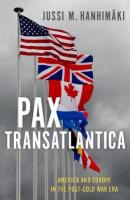
Pax Transatlantica
Pax Transatlantica
No customer reviews yet
ISBN 9780190922160
Oxford University Press, USA
A bold argument that tackles current trends, such as rising nationalism, arguing that they strengthen rather than undermine transatlantic ties.
Is the West finished as a political idea? In recent years, observers have begun pointing to signs that this transatlantic community is eroding. When the European Union expanded, the classic European nation state was in decline. Now, nationalism is on the rise. Furthermore, nations within the EU are
less willing to cooperate with the US on policies that require sacrifice and risks, such as using military force alongside the US. Today, following the twin shocks of Brexit and Trump's election, the concept of a unified Western transatlantic community seems to be a relic. But, in Pax
Transatlantica, the international historian Jussi Hanhim�ki explains why the West is far from over.
Hanhim�ki argues that-despite Trump's inflammatory, dismissive rhetoric-NATO continues to provide robust security for its member states. NATO has survived by expanding its remit and scope, and it is viewed favorably by member states overall. Moreover, the transatlantic relationship boasts the
richest and most closely connected transcontinental economy in the world. Despite the potential fallout from current trade wars-especially between the US and China-and the rise of economic nationalism, the West still benefits from significant transatlantic trade and massive investment flows. Lastly,
Hanhim�ki traces the parallel evolution of domestic politics on both sides of the Atlantic, focusing on the rise of populism. He contends that populism is not causing a rift between the US and Europe. Rather, the spread of populism evinces that their politics are in fact closely integrated.
Shifts and even crises abound in the history of the transatlantic relationship. Still, the West endures. Conflicts, rather than undermining the relationship, illustrate its resilience. Hanhim�ki shows that the transatlantic relationship is playing out this cycle today. Not only will the "Pax
Transatlantica" continue to exist, Hanhim�ki concludes, it is likely to thrive in the future.
"Pax Transatlantica asserts that the recurrent transatlantic crises that have dominated headlines since the end of the Cold War, while not irrelevant, pale when set against the realities of shared interests and goals. It emphasizes three key factors. First, despite inflammatory and dismissive rhetoric, NATO continues to provide a solid security structure for its member states; an institutional framework of a Pax Transatlantica that has stood the test of time by expanding its remit and scope. Second, in a world concerned with the potential effects of trade wars (especially between the US and China) and the rise of economic nationalism, the transatlantic economic relationship stands apart as the richest, most closely integrated transcontinental economic space on the globe. Third, the book will trace the parallel evolution of domestic politics on both sides of the Atlantic with specific focus on the rise of populism. Rather than a sign of transatlantic 'drift,' the rise of populism - much like the emergence of so-called 'Third Way politics on both sides of the Atlantic in the 1990s - is evidence of a closely integrated transatlantic political space. In the end, while it is obvious that the history of the transatlantic relationship - even during the Cold War - was littered with crises, the relationship has endured. Conflicts have illustrated, time and again, the strength of the transatlantic community. The 'West', the book concludes, not only continues to exist. It is likely to thrive in the future"
"If you are looking for one book that explains the post-World War II history of transatlantic military, economic, and political relations up to the present day, you need look no further. In this masterful work, Hanhim�ki explains the close ties--and inevitable conflicts--that have and will continue to
mark America's relations with its European partners." -- James Goldgeier, Professor of International Relations, American University
"No one knows more about the transatlantic relationship than Jussi Hanhim�ki. This book, published on the heels of a destructive Trump presidency, is a welcome reminder that the community has suffered frequent travails but retains sources of enduring strength." -- Hal Brands, Professor of Global
Affairs, Johns Hopkins-SAIS, and Scholar, American Enterprise Institute
"Pax Transatlantica offers compelling evidence that transatlantic economic, political, and military ties will endure. Hanhim�ki shows how recent crises reflect continued interdependence, and he explains why NATO will remain strong in coming years. Everyone interested in American relations with
Europe should read this smart, powerful book." -- Jeremi Suri, Professor of History, University of Texas at Austin and author of The Impossible Presidency
"This spirited, immensely enjoyable book is the smartest commentary on US-European relations in a long time. With wit and insight, Hanhim�ki shows how the Pax Transatlantica has created our world and that it's more robust and resilient than we often assume. This book is a tonic for our troubled
times." -- Andrew Preston, Professor of American History, Cambridge University
"In this shrewd volume by one of the most original writers on the transatlantic relationship Hanhim�ki explains in crystal clear language why in spite of the various crises it has experienced what he calls Pax Transatlantica continues to form the bedrock upon which the international order rests. A
wise, necessary and uplifting book that everybody needs to read in the wake of the wrecking ball called Trump." -- Michael Cox, Emeritus Professor of International Relations and Founding Director of LSE IDEAS, London School of Economics
"Hanhim�ki, one of the leading historians of international relations, has written a refreshingly optimistic book in the midst of the pervasive pessimism and gloom created by the coronavirus pandemic. In extraordinarily concise fashion, he provides rich historical context and perspective to the
intricate ways--politically, economically, and in terms of security--the United States and Europe are bound together in what he calls, Pax Transatlantica, a community that embraces both conflict and cooperation, always seeming to be on the verge of crisis and decline, but still persevering and
enduring. A brilliant and incisive treatment of one of the most fundamental features of international life in the 21st century." -- Thomas Schwartz, Professor of History and Political Science, Vanderbilt University, and author of Henry Kissinger and American Power
"Hanhim�ki enjoys a unique advantage as an author.�He knows the American and European sides of the transatlantic relationship supremely well, but as a Finnish-Swiss double citizen--in his words, a 'super-neutral'--he also maintains critical distance from both sides. This unique vantage point enables
the author to examine today's economic, political, and security issues with a fresh eye--showing how, as he wisely puts it, the transatlantic relationship is 'a great success story that is always on the brink of catastrophe.' Highly recommended for scholars and general readers alike." -- Mary Elise
Sarotte, author of The Collapse
"Hanhim�ki has produced a concise, well-argued study of recent transatlantic relations, which exposes the fact that its recent troubles are neither unique nor new. For those seeking a sound overview of the field, they would be hard-put to find something better." -- Alan Dobson, Professor of
Politics, University of Dundee
About the author
Product details
BrandOxford University Press, USA
Pub dateJun 18, 2021
ISBN-100190922168
ISBN-139780190922160
Pages208
Dimensions6.3 × 9.4 × 1 in
Last updated 2021-06-21 02:29
$31.02
$37.99
18% off
You save $6.97 · list price $37.99
In stock — ships in 24 hours with free tracking
Delivery by Wednesday, September 9, 2026
Sign in to Add to Saved list
Fast checkout
Pay with Apple Pay or Google Pay when available.
Payment received
We are registering your order now. Please stay on this page while we redirect you to the confirmation page.
Free delivery on orders over $35.
15-day returns. Any reason.
Secure checkout. We never store card details.
Readers who bought this also bought
More from World - General