
Home/
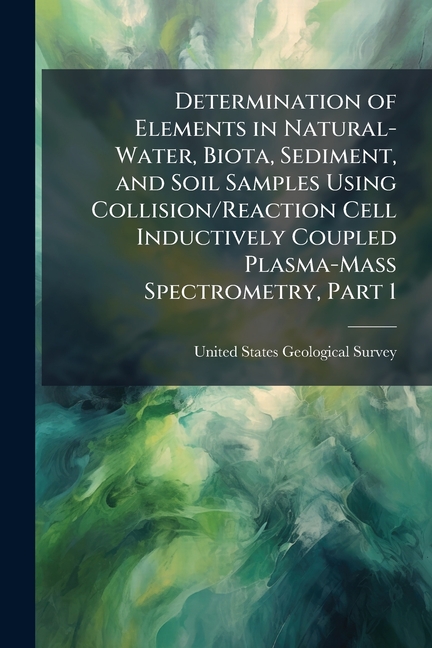
Determination of Elements in Natural-Water, Biota, Sediment, and Soil Samples Using Collision/Reacti
Determination of Elements in Natural-Water, Biota, Sediment, and Soil Samples Using Collision/Reacti
No customer reviews yet
ISBN 9781025055794
A new analytical method for the determination of elements in filtered aqueous matrices using inductively coupled plasma-mass spectrometry (ICP-MS) has been implemented at the U.S. Geological Survey National Water Quality Laboratory that uses collision/reaction cell technology to reduce molecular ion interferences. The updated method can be used to determine elements in filtered natural-water and other filtered aqueous matrices, including whole-water, biota, sediment, and soil digestates. Helium or hydrogen is used as the collision or reaction gas, respectively, to eliminate or substantially reduce interferences commonly resulting from sample-matrix composition. Helium is used for molecular ion interferences associated with the determination of As, Co, Cr, Cu, K, Mg, Na, Ni, V, W and Zn, whereas hydrogen is used for Ca, Fe, Se, and Si. Other elements that are not affected by molecular ion interference also can be determined simply by not introducing a collision/reaction gas into the cell. Analysis time is increased by about a factor of 2 over the previous method because of the additional data acquisition time in the hydrogen and helium modes. Method detection limits for As, Ca, Co, Cr, Cu, Fe, K, Mg, Na, Ni, Se, Si (as SiO2), V, W, and Zn, all of which use a collision/reaction gas, are 0.06 microgram per liter (?g/L) As, 0.04 milligram per liter (mg/L) Ca, 0.02 ?g/L Co, 0.02 ?g/L Cr, 0.04 ?g/L Cu, 1 ?g/L Fe, 0.007 mg/L K, 0.009 mg/L Mg, 0.09 mg/L Na, 0.05 ?g/L Ni, 0.04 ?g/L Se, 0.03 mg/L SiO2, 0.05 ?g/L V, 0.03 ?g/L W, and 0.04 ?g/L Zn. Most method detection limits are lower or relatively unchanged compared to earlier methods except for Co, K, Mg, Ni, SiO2, and Tl, which are less than a factor of 2 higher. Percentage bias for samples spiked at about one-third and two-thirds of the concentration of the highest calibration standard ranged from -8.1 to 7.9 percent for reagent water, -14 to 21 percent for surface water, and -16 to 16 percent for ground water. The percen
This work has been selected by scholars as being culturally important, and is part of the knowledge base of civilization as we know it. This work was reproduced from the original artifact, and remains as true to the original work as possible. Therefore, you will see the original copyright references, library stamps (as most of these works have been housed in our most important libraries around the world), and other notations in the work.
This work is in the public domain in the United States of America, and possibly other nations. Within the United States, you may freely copy and distribute this work, as no entity (individual or corporate) has a copyright on the body of the work.
As a reproduction of a historical artifact, this work may contain missing or blurred pages, poor pictures, errant marks, etc. Scholars believe, and we concur, that this work is important enough to be preserved, reproduced, and made generally available to the public. We appreciate your support of the preservation process, and thank you for being an important part of keeping this knowledge alive and relevant.
About the author
Product details
Pub dateMay 22, 2025
ISBN-101025055799
ISBN-139781025055794
LanguageEnglish
Last updated 2026-04-25 06:02
$16.89
$17.95
5% off
You save $1.06 · list price $17.95
In stock — ships in 24 hours with free tracking
Delivery by Tuesday, September 8, 2026
Sign in to Add to Saved list
Fast checkout
Pay with Apple Pay or Google Pay when available.
Payment received
We are registering your order now. Please stay on this page while we redirect you to the confirmation page.
Free delivery on orders over $35.
15-day returns. Any reason.
Secure checkout. We never store card details.
Readers who bought this also bought
More from Chemistry - Environmental (see also Environmental Science)