Skip to content
Home/ Planetary Protection Considerations for Missions to Solar System Small Bodies: Report Series--Commit
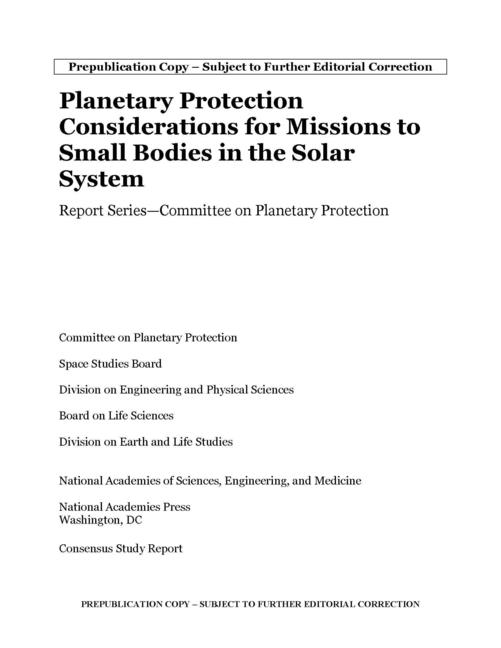
Planetary Protection Considerations for Missions to Solar System Small Bodies: Report Series--Commit

Planetary Protection Considerations for Missions to Solar System Small Bodies: Report Series--Commit

No customer reviews yet ISBN 9780309693721

The ultimate goal of planetary protection for outbound missions is to prevent harmful contamination that would inhibit future measurements designed to search for evidence of the existence or evolution of extraterrestrial life. Preventing harmful contamination is achieved by following specific guidelines based on existing scientific knowledge about the destination and the type of mission. This report responds to NASA's request for a study on planetary protection categorization of missions to small bodies, including whether there are particular populations of small bodies for which contamination of one object in the population would not be likely to have a tangible effect on the opportunities for scientific investigation using other objects in the population. In addressing NASA's request, the authoring committee considered surface composition of target bodies and their importance for prebiotic chemistry, along with size of the small-body populations, the current state of knowledge on the types of objects, the likelihood of a future scientific mission returning to any specific object, active object surface processes, and the size.

About the author

Product details

Pub dateAug 11, 2023
ISBN-100309693721
ISBN-139780309693721
LanguageEnglish
Last updated 2025-11-15 07:27
$24.21
In stock soon — order now to reserve your copy
Delivery by Monday, September 7, 2026
Qty
Sign in to Add to Saved list
Free delivery on orders over $35.
15-day returns. Any reason.
Secure checkout. We never store card details.

Readers who bought this also bought

More from Space Science - General
See all
Primitive Meteorites and Asteroids
<p><i>Primitive Meteorites and Asteroids: Physical, Chemical, and Spectroscopic Observations Paving the Way to Exploration </i>covers the physical, chemical and spectroscopic aspects of asteroids, providing important data and research on carbonaceous chondrites and primitive meteorites. This information is crucial to the success of missions to parent bodies, thus contributing to an understanding of the early solar system. The book offers an interdisciplinary perspective relevant to many fields of planetary science, as well as cosmochemistry, planetary astronomy, astrobiology, geology and space engineering.</p> <p>Including contributions from planetary and missions scientists worldwide, the book collects the fundamental knowledge and cutting-edge research on carbonaceous chondrites and their parent bodies into one accessible resource, thus contributing to the future of space exploration. </p><br>Dr. Abreu is a Planetary Scientist with a background in geochemistry, mineralogy, petrology, physics, and astronomy. Dr. Abreu's interests are: (1) determining the effects of asteroidal processes that resulted in the mineralogical and petrologic characteristics of chondrites, including brecciation, aqueous alteration, thermal metamorphism, and shock metamorphism&#x3b; (2) understanding the origin and distribution of volatiles and organics in chondritic meteorites, including hydrated silicates&#x3b; (3) determining the spatial scale of chemical compositional variations resulting from processes operating on asteroidal regoliths&#x3b; (4) using chondrites to constrain the composition and structure of asteroidal regoliths and (5) determining what can be learned about asteroidal regoliths from proximity and contact exploration. Dr. Abreu has published and refereed numerous peer-reviewed articles on the characteristics of carbonaceous chondrites. She has served as the principal of a NASA grant and collaborator in several others. She was part of the 2009-2010 Antarctic Search for Meteorites field season, for which she received the NSF Antarctic Service Medal. Dr. Abreu has been part of numerous NASA grant review panels and served in the program committees of national and international conferences.<br>
$185.10