
Home/
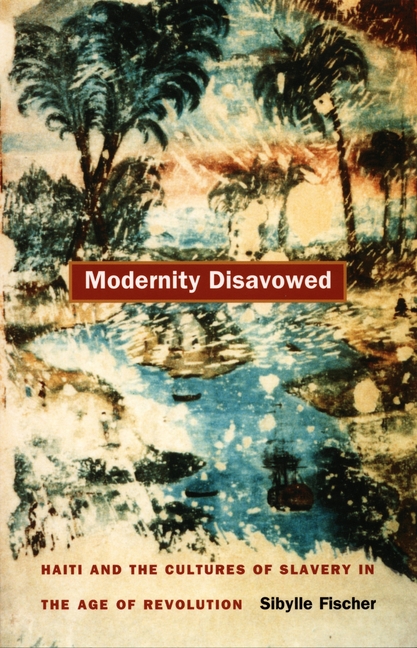
Modernity Disavowed: Haiti and the Cultures of Slavery in the Age of Revolution
Modernity Disavowed: Haiti and the Cultures of Slavery in the Age of Revolution
No customer reviews yet
ISBN 9780822332909
Duke University Press Books
Modernity Disavowed is a pathbreaking study of the cultural, political, and philosophical significance of the Haitian Revolution (1791-1804). Revealing how the radical antislavery politics of this seminal event have been suppressed and ignored in historical and cultural records over the past two hundred years, Sibylle Fischer contends that revolutionary antislavery and its subsequent disavowal are central to the formation and understanding of Western modernity. She develops a powerful argument that the denial of revolutionary antislavery eventually became a crucial ingredient in a range of hegemonic thought, including Creole nationalism in the Caribbean and G. W. F. Hegel's master-slave dialectic.
Fischer draws on history, literary scholarship, political theory, philosophy, and psychoanalytic theory to examine a range of material, including Haitian political and legal documents and nineteenth-century Cuban and Dominican literature and art. She demonstrates that at a time when racial taxonomies were beginning to mutate into scientific racism and racist biology, the Haitian revolutionaries recognized the question of race as political. Yet, as the cultural records of neighboring Cuba and the Dominican Republic show, the story of the Haitian Revolution has been told as one outside politics and beyond human language, as a tale of barbarism and unspeakable violence. From the time of the revolution onward, the story has been confined to the margins of history: to rumors, oral histories, and confidential letters. Fischer maintains that without accounting for revolutionary antislavery and its subsequent disavowal, Western modernity-including its hierarchy of values, depoliticization of social goals having to do with racial differences, and privileging of claims of national sovereignty-cannot be fully understood.
About the author
Product details
BrandDuke University Press Books
Pub dateApr 30, 2004
ISBN-100822332906
ISBN-139780822332909
LanguageEnglish
Dimensions9.5 × 0.96 × 6.5 in
Weight1 lb
Last updated 2026-04-25 07:29
$41.83
In stock — ships in 24 hours with free tracking
Delivery by Monday, September 14, 2026
Sign in to Add to Saved list
Fast checkout
Pay with Apple Pay or Google Pay when available.
Payment received
We are registering your order now. Please stay on this page while we redirect you to the confirmation page.
Free delivery on orders over $35.
15-day returns. Any reason.
Secure checkout. We never store card details.
Readers who bought this also bought
More from Caribbean & West Indies - General