
Skip to content
Home/ Single-Family Builder Compensation Study, 2022 Edition
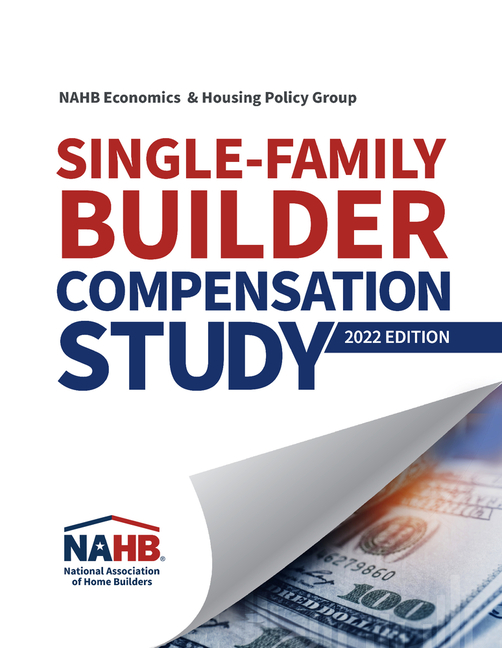
Single-Family Builder Compensation Study, 2022 Edition

Single-Family Builder Compensation Study, 2022 Edition

No customer reviews yet ISBN 9780867188004 BuilderBooks

Find the Salary, Bonus, and Benefits Data for 39 Single-Family Builder Positions Discover how other single-family builders are compensating their employees with pay and benefits. Uncover the data compiled in the Single-Family Builder Compensation Study, 2022 Edition to benchmark the compensation and benefits you should be offering your employees. The NAHB Economics & Housing Policy Group collected compensation and benefits data for 39 common positions at single-family home building companies. The data was analyzed by region, 2021 dollar volume, 2021 single-family starts, and number of employees on the payroll. Review the findings from two different perspectives: Compensation and Benefits for 39 Positions-- a broad view of the full-time positions that currently exist at single-family building companies, a comparison of average total compensation and benefits across position and Compensation and Benefits by Position-- a detailed view of the average compensation and benefits for each position.

About the author

Product details

BrandBuilderBooks
Pub dateDec 26, 2022
ISBN-100867188006
ISBN-139780867188004
Paperback270.0 pages
LanguageEnglish
Dimensions11 × 0.7 × 8.5 in
Weight2 lb
Last updated 2026-04-25 09:21
$104.22 $149.95 30% off
You save $45.73 · list price $149.95
In stock soon — order now to reserve your copy
Delivery by Monday, October 19, 2026
Qty
Sign in to Add to Saved list
Free delivery on orders over $35.
15-day returns. Any reason.
Secure checkout. We never store card details.

Readers who bought this also bought

More from Industries - Construction
See all
Describing Construction: Industries, Projects and Firms
<p>This third book from editors Rick Best and Jim Meikle brings together and presents insights into a number of key concepts in the study of construction firms, projects and the group of activities that loosely define the construction industry. The value for readers comes from the collection of a variety of topics in a single volume, which provide a basic understanding of the complexities of construction as more than a set of practical concerns such as labour management and materials handling. Instead, the focus is on analysis of the industry and its component parts from the viewpoints of construction economists and others seeking to understand the drivers and challenges that shape an area of economic activity that is a major contributor in all economies.</p><p>The aim of this book is to provide an overview and discussion of several aspects of what makes construction tick. It is unlike other industry sectors in many ways, being project-based with often intense competition for work. Where the first book, <i>Measuring Construction, </i>focused on particular areas associated with quantifying various aspects of construction activity and the second, <i>Accounting for Construction, </i> looked more at how we record and report on construction activity, <i>Describing Construction</i> gives readers the views of experts in the field of how the construction industry is described, what its make-up is, it even asks the question: is construction a single industry? This book will change the way most readers understand the 'construction industry', whatever that may be, not from the point of view of visible on-site activities, but through a scientific approach to analysis and understanding of how projects, firms and various sectors of the industry work and how things are changing and may continue to change in future. It is essential reading for students and researchers in construction management, quantity surveying, architecture and engineering.</p>
$260.17
Describing Construction: Industries, Projects and Firms
<p>This third book from editors Rick Best and Jim Meikle brings together and presents insights into a number of key concepts in the study of construction firms, projects and the group of activities that loosely define the construction industry. The value for readers comes from the collection of a variety of topics in a single volume, which provide a basic understanding of the complexities of construction as more than a set of practical concerns such as labour management and materials handling. Instead, the focus is on analysis of the industry and its component parts from the viewpoints of construction economists and others seeking to understand the drivers and challenges that shape an area of economic activity that is a major contributor in all economies.</p><p>The aim of this book is to provide an overview and discussion of several aspects of what makes construction tick. It is unlike other industry sectors in many ways, being project-based with often intense competition for work. Where the first book, <i>Measuring Construction, </i>focused on particular areas associated with quantifying various aspects of construction activity and the second, <i>Accounting for Construction, </i> looked more at how we record and report on construction activity, <i>Describing Construction</i> gives readers the views of experts in the field of how the construction industry is described, what its make-up is, it even asks the question: is construction a single industry? This book will change the way most readers understand the 'construction industry', whatever that may be, not from the point of view of visible on-site activities, but through a scientific approach to analysis and understanding of how projects, firms and various sectors of the industry work and how things are changing and may continue to change in future. It is essential reading for students and researchers in construction management, quantity surveying, architecture and engineering.</p>
$88.65