
Home/
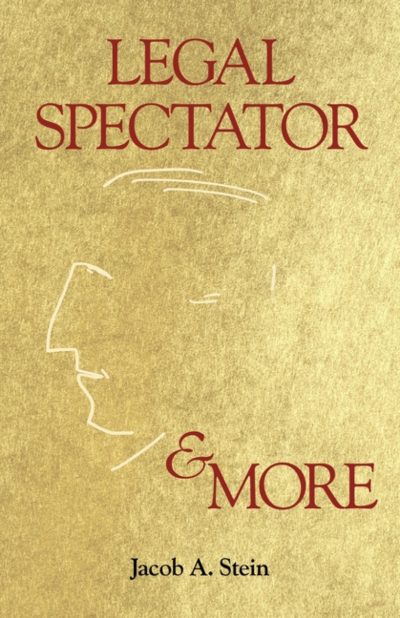
Legal Spectator & More
Legal Spectator & More
No customer reviews yet
ISBN 9781587331794
TheCapitol.Net
A compilation of Washington, DC, attorney Jacob Stein's essays about lawyers, judges, clients, literature, and popular culture. The essays in this volume have previously appeared in Washington Lawyer, American Scholar, the Times Literary Supplement, and Wilson Quarterly.
From the Author:
One of these days a tired lawyer, in retreat from the quickly running statute of limitations, and hiding out in a bookstore as I have done, will discover this book. And it may just happen that one or two of the remarks that follow will remind the tired counselor that the ungrateful client, the unresponsive judge, the damnation of deadlines are all common to those of us who must extract a living from the contention of others.
About the Author:
Jacob A. Stein has been a trial lawyer for more than 55 years. Mr. Stein received an LL.B. in 1948 from George Washington University. His practice includes a wide variety of civil and criminal litigation, particularly the prosecution of personal injury claims. His books include: Legal Spectator & More (2003); The Law of Law Firms (1994); Closing Argument, The Art and the Law (1969); Trial Handbook for Maryland Lawyers (1972-2001); District of Columbia Tort Casefinder (1977 & 1983 supp.); Personal Injury Damages (2nd ed. 1991); Damages and Recovery, A Survey of the Law of Damages (1972).
He is senior editor of Litigation magazine. He is adjunct professor at Georgetown U. Law School, where he teaches an advanced course in the Federal Rules of Evidence. He also has participated in many continuing education programs and has taught in the Harvard Law School trial practice course from 1974 through 1983.
He is past president of the District of Columbia Bar and of the Bar Association of the District of Columbia. He served as chairman of the Local Rules Committee of the U. S. District Court for the District of Columbia. Mr. Stein is a Fellow of the American College of Trial Lawyers.
Complete Table of Contents and links to past articles at LegalSpectatorAndMore.com
About the author
Product details
BrandTheCapitol.Net
Pub dateFeb 20, 2009
ISBN-101587331799
ISBN-139781587331794
LanguageEnglish
Dimensions8.5 × 0.88 × 5.5 in
Weight1 lb
Last updated 2026-07-29 00:46
$24.28
$25.95
6% off
You save $1.67 · list price $25.95
In stock — ships in 24 hours with free tracking
Delivery by Monday, September 14, 2026
Sign in to Add to Saved list
Fast checkout
Pay with Apple Pay or Google Pay when available.
Payment received
We are registering your order now. Please stay on this page while we redirect you to the confirmation page.
Free delivery on orders over $35.
15-day returns. Any reason.
Secure checkout. We never store card details.
Readers who bought this also bought
More from Legal Profession