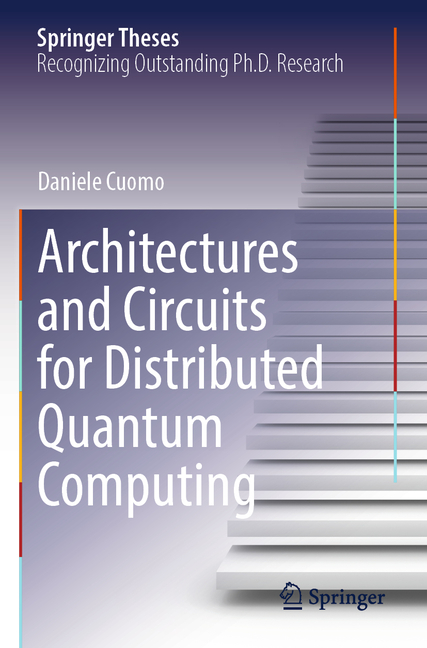
Architectures and Circuits for Distributed Quantum Computing
$189.30
Payment received
We are registering your order now. Please stay on this page while we redirect you to the confirmation page.
- In Stock soon, order now to reserve your copy.
- FREE DELIVERY
- Secure checkout
- 15-day returns
- 24/24 Online
- Yes High Speed
- Yes Protection
Description
This thesis treats networks providing quantum computation based on distributed paradigms. Compared to architectures relying on one processor, a network promises to be more scalable and less fault-prone. Developing a distributed system able to provide practical quantum computation comes with numerous challenges, each of which need to be faced with careful analysis in order to create a seamless integration of multiple engineered components.
In accordance with hardware technologies, currently under development worldwide, telegates represent the fundamental inter-processor operations. Each telegate consists of several tasks: i) entanglement generation and distribution, ii) local operations, and iii) classical communications. Entanglement generation and distribution is an expensive resource, as it is time-consuming. The primary contribution of this thesis lies in the extensive analysis of some complex scenarios of general interest. We propose numerical models that help to identifythe interdependence between computation and communication. With the support of some of the best tools for reasoning -- i.e. network optimization, circuit manipulation, group theory and ZX-calculus -- we lay out new perspectives on the way a distributed quantum computing system should be developed.
Product Details
- Jan 14, 2026 Pub Date:
- 3031738101 ISBN-10:
- 9783031738104 ISBN-13:
- English Language
Fast moving this week
 Chainsaw Man Box Set
$93.87
Chainsaw Man Box Set
$93.87
 National Geographic Atlas of the World, 11th Edition
$183.40
National Geographic Atlas of the World, 11th Edition
$183.40
 Invincible Compendium Volume 2
$51.64
Invincible Compendium Volume 2
$51.64
 Naruto Box Set 2: Volumes 28-48 with Premium
$128.57
Naruto Box Set 2: Volumes 28-48 with Premium
$128.57
 Diary: Divine Mercy in My Soul (Revised)
$11.61
Diary: Divine Mercy in My Soul (Revised)
$11.61
 Netter's Anatomy Flash Cards
$41.84
Netter's Anatomy Flash Cards
$41.84
 It's Not You: Identifying and Healing from Narcissistic People
$18.57
It's Not You: Identifying and Healing from Narcissistic People
$18.57
 Amygdala
$49.86
Amygdala
$49.86
 Mom, I Want to Hear Your Story: A Mother's Guided Journal To Share Her Life & Her Love
$13.71
Mom, I Want to Hear Your Story: A Mother's Guided Journal To Share Her Life & Her Love
$13.71

Money Back
Love it! Use it! Reuse it!

Free Shipping
Shipping is on us

Free Support
24/24 available