click to view more
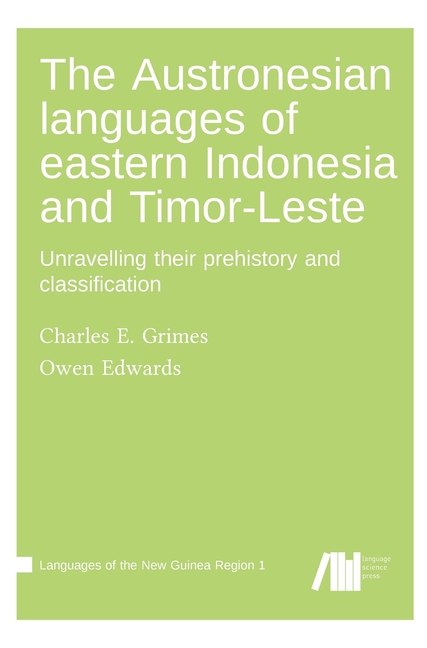
Austronesian languages of eastern Indonesia and Timor-Leste: Unravelling their prehistory and classi
by Edwards, Owen
$118.43
List Price: $150.00
Save: $31.57 (21%)
Fast checkout
Pay with Apple Pay or Google Pay when available.
Payment received
We are registering your order now. Please stay on this page while we redirect you to the confirmation page.
- In Stock - Ship in 24 hours with Free Online tracking.
- FREE DELIVERY by Tuesday, April 28, 2026
- Secure checkout
- 15-day returns
- 24/24 Online
- Yes High Speed
- Yes Protection
Description
For 150 years there has been a question over how the Austronesian languages of eastern Indonesia and Timor-Leste fit into the Austronesian world. The area is severely under-documented. There has been no consensus on the classification of these languages, and scholars admit to being perplexed. This is the first systematic attempt at subgrouping the whole region based on historical phonology, supplemented by morphosyntax and the lexicon. Insights from archaeology, DNA studies, and awareness of long-term contact with Papuan languages inform this study. Nine Wallacean subgroups are identified, along with their internal structures. Light is shed on languages whose classification has been unclear. Discontinuities in the historical phonology suggest different groups speaking different Austronesian languages got off different boats at different places, probably at different times. No evidence is found supporting a monolithic Austronesian advance through the region, nor a common Austronesian parent language below PMP that links all Wallacean subgroups. Speakers of SVO Austronesian languages with prepositions, preverbal negation, numbers before nouns, and post-posed possessors came into contact with speakers of languages of unrelated Papuan families, with postpositions, clause-final negation, numbers following nouns, preposed possessors, and other features of SOV languages. Austronesian languages adopted these features but not uniformly, such that features attributed to contact are uneven across the region. Some are not found in some subgroups or branches within subgroups. Distribution maps of phonological, grammatical, and lexical features show many features are not found in all subgroups, do not align with each other, and some are found outside the region. Austronesian languages in the region are a kind of uneven hybrid that make them typologically different from Austronesian languages to the west and north. The study evaluates earlier proposals along with new possibilities
Last updated on
Product Details
- Mar 31, 2026 Pub Date:
- 3985541787 ISBN-10:
- 9783985541782 ISBN-13:
- English Language
Buyer favorite
Fast moving this week
 Chainsaw Man Box Set
$93.87
Chainsaw Man Box Set
$93.87
 National Geographic Atlas of the World, 11th Edition
$183.40
National Geographic Atlas of the World, 11th Edition
$183.40
 Invincible Compendium Volume 2
$51.64
Invincible Compendium Volume 2
$51.64
 Naruto Box Set 2: Volumes 28-48 with Premium
$128.57
Naruto Box Set 2: Volumes 28-48 with Premium
$128.57
 Diary: Divine Mercy in My Soul (Revised)
$11.61
Diary: Divine Mercy in My Soul (Revised)
$11.61
 Netter's Anatomy Flash Cards
$41.84
Netter's Anatomy Flash Cards
$41.84
 It's Not You: Identifying and Healing from Narcissistic People
$18.57
It's Not You: Identifying and Healing from Narcissistic People
$18.57
 Amygdala
$49.86
Amygdala
$49.86
 Mom, I Want to Hear Your Story: A Mother's Guided Journal To Share Her Life & Her Love
$13.71
Mom, I Want to Hear Your Story: A Mother's Guided Journal To Share Her Life & Her Love
$13.71

Money Back
Love it! Use it! Reuse it!

Free Shipping
Shipping is on us

Free Support
24/24 available