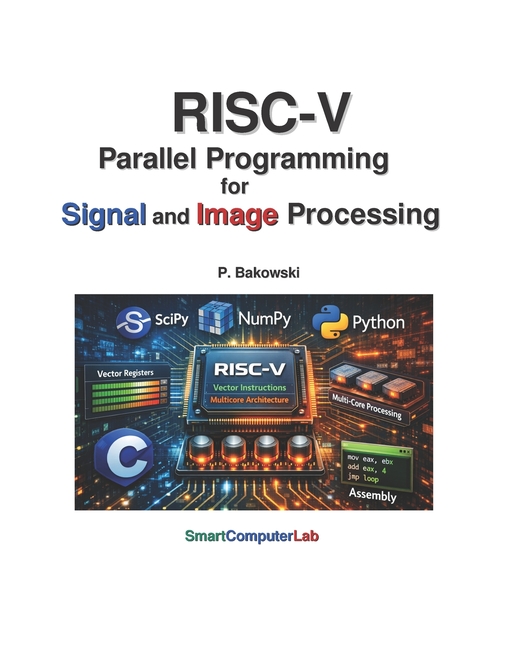
RISC-V Parallel Programming for Signal and Image Processing
$16.05
Payment received
We are registering your order now. Please stay on this page while we redirect you to the confirmation page.
- In Stock - Ship in 24 hours with Free Online tracking.
- FREE DELIVERY by Tuesday, April 28, 2026
- Secure checkout
- 15-day returns
- 24/24 Online
- Yes High Speed
- Yes Protection
Description
RISC-V represents a significant shift in the field of processor design. Unlike traditional proprietary instruction set architectures, RISC-V is open, modular, and freely available. This openness has encouraged rapid innovation in universities, research laboratories, and industry alike.
Designers are free to implement, extend, and optimize the architecture according to the needs of specific applications. The clean and well-structured design of RISC-V also makes it particularly suitable for both high-performance computing platforms and modern embedded systems.
As a result, it has become one of the most promising foundations for the next generation of computing technologies.
A central theme of this book is performance through parallelism. Modern RISC-V processors combine multicore architectures with powerful vector-processing capabilities. Multicore systems improve performance by executing multiple tasks simultaneously, while the RISC-V vector extension enables a single instruction to operate on multiple data elements at once.
This form of data-level parallelism is especially well suited to applications in signal and image processing, where the same operations are repeatedly applied to large data sets. By combining multicore execution with vector operations, RISC-V offers a scalable and energy-efficient computing model capable of addressing demanding real-world problems.
Another important aspect of this book is the role of Python as a high-level development environment. Python has become one of the most widely used languages in scientific and engineering applications thanks to its clear syntax, readability, and extensive ecosystem of libraries.
Optimized libraries such as NumPy, SciPy, and OpenCV allow developers to implement complex algorithms quickly and with relatively little code. Although Python itself is a high-level language, many of its scientific libraries rely on highly optimized low-level implementations.
This makes it possible to combine the productivity of Python with the performance of optimized numerical routines, including those that take advantage of vector instructions and other hardware-acceleration features available on modern RISC-V processors.
This book aims to bridge the gap between architectural concepts and practical algorithm development. It explains how computationally intensive operations can be implemented efficiently while remaining accessible to readers who may not have extensive experience in low-level programming.
Through a series of practical examples, the book demonstrates how modern RISC-V processors and high-level programming tools can work together to create efficient, portable, and scalable solutions.
Ultimately, this book is intended for students, researchers, and engineers who are interested in high-performance computing, signal processing, image processing, and modern processor architectures.
Whether the reader is approaching RISC-V for the first time or seeking to deepen their understanding of parallel computing techniques, the goal of this work is to provide a clear and practical path toward efficient algorithm design on one of the most promising computing platforms of our time.
Product Details
- Mar 27, 2026 Pub Date:
- 9798253911853 ISBN-10:
- 9798253911853 ISBN-13:
- English Language
Fast moving this week
 Chainsaw Man Box Set
$93.87
Chainsaw Man Box Set
$93.87
 National Geographic Atlas of the World, 11th Edition
$183.40
National Geographic Atlas of the World, 11th Edition
$183.40
 Invincible Compendium Volume 2
$51.64
Invincible Compendium Volume 2
$51.64
 Naruto Box Set 2: Volumes 28-48 with Premium
$128.57
Naruto Box Set 2: Volumes 28-48 with Premium
$128.57
 Diary: Divine Mercy in My Soul (Revised)
$11.61
Diary: Divine Mercy in My Soul (Revised)
$11.61
 Netter's Anatomy Flash Cards
$41.84
Netter's Anatomy Flash Cards
$41.84
 It's Not You: Identifying and Healing from Narcissistic People
$18.57
It's Not You: Identifying and Healing from Narcissistic People
$18.57
 Amygdala
$49.86
Amygdala
$49.86
 Mom, I Want to Hear Your Story: A Mother's Guided Journal To Share Her Life & Her Love
$13.71
Mom, I Want to Hear Your Story: A Mother's Guided Journal To Share Her Life & Her Love
$13.71

Money Back
Love it! Use it! Reuse it!

Free Shipping
Shipping is on us

Free Support
24/24 available