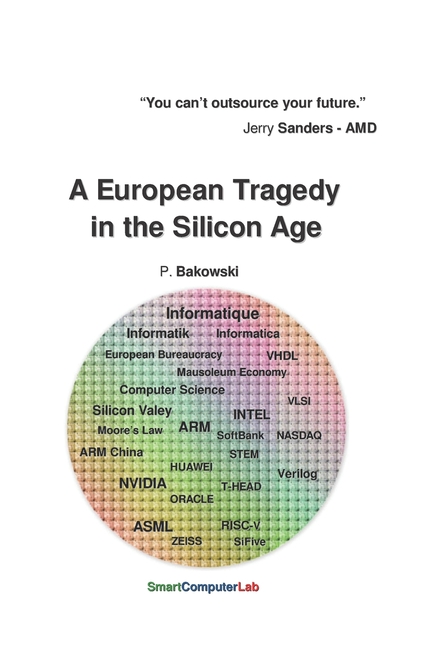
European Tragedy in the Silicon Age
$14.48
Payment received
We are registering your order now. Please stay on this page while we redirect you to the confirmation page.
- In Stock - Ship in 24 hours with Free Online tracking.
- FREE DELIVERY by Tuesday, April 28, 2026
- Secure checkout
- 15-day returns
- 24/24 Online
- Yes High Speed
- Yes Protection
Description
This book traces the historical, cultural, and structural forces shaping Europe's complex relationship with modern computing. It begins with the intellectual origins of Informatics in Europe, a discipline that emerged before integrated circuits and microprocessors transformed global technology.
Early European computing emphasized logic, algorithms, formal methods, and symbolic reasoning, developing largely independently of semiconductor physics and hardware engineering. As a result, when the silicon revolution arrived, Europe was intellectually advanced but industrially unprepared.
The narrative then shifts to the United States, where the rise of the silicon age fused computer science, electrical engineering, and entrepreneurship into a single ecosystem.
Silicon Valley's integrated model-spanning VLSI design, fabrication, microarchitecture, software, operating systems, and venture capital-produced the first microprocessors and laid the foundation for enduring technological dominance.
With the rise of fabless semiconductor companies in the 1990s and 2000s, the global center of gravity shifted again. Design and manufacturing separated, concentrating value in scalable production ecosystems.
Within this transformation, ARM, a British company built on a low-power RISC architecture, became the global standard for mobile and embedded systems, powering billions of devices. Yet ARM's success did not spark a broader European computing renaissance.
Once home to pioneering firms such as Olivetti, Bull, Siemens, and ICL, Europe lost ground as American and Asian competitors scaled semiconductor manufacturing and personal computing globally. ARM's 2016 sale to SoftBank symbolized not just a corporate transaction but a decisive loss of European control over a widely deployed processor architecture, exposing Europe's industrial vulnerability.
This decline reflects a deeper structural paradox. Europe hosts ASML, the world's sole producer of extreme ultraviolet lithography systems essential for sub-5 nm chip production, yet it lacks the large-scale fabs to use them. Europe mastered the tools of the semiconductor age but not the factories, supplying critical technology while others operate the production.
Europe's universities have trained generations of leading researchers in computer science and engineering, yet many graduates, including foreign PhD students, join semiconductor and AI firms abroad. Talent flows out, and foreign-owned R&D centers, such as those established by Huawei, often strengthen technological leadership outside Europe.
The continent generates knowledge, but scaling and monetizing it frequently occur elsewhere.
Looking forward, RISC-V, the open instruction set architecture, offers Europe a rare opportunity to shape a sovereign computing platform. Free from proprietary control, RISC-V could enable architectural independence. Yet Europe still lacks the industrial scale, financial resources, and strategic coordination that underpin China's and the U.S.'s successes.
Without significant investment and a cultural shift toward integrated hardware-software development, even this opportunity may slip away.
From the birth of Informatics to the global silicon order; from ARM's rise to Europe's missed industrial chances; from research outposts to the promise of RISC-V, this narrative traces the forces behind Europe's technological weakening.
It highlights a defining contradiction: a continent capable of producing the world's most advanced semiconductor tools, yet unable to anchor the production ecosystems necessary to secure its own digital future.
Product Details
- Mar 30, 2026 Pub Date:
- 9798254297062 ISBN-10:
- 9798254297062 ISBN-13:
- English Language
Fast moving this week
 Chainsaw Man Box Set
$93.87
Chainsaw Man Box Set
$93.87
 National Geographic Atlas of the World, 11th Edition
$183.40
National Geographic Atlas of the World, 11th Edition
$183.40
 Invincible Compendium Volume 2
$51.64
Invincible Compendium Volume 2
$51.64
 Naruto Box Set 2: Volumes 28-48 with Premium
$128.57
Naruto Box Set 2: Volumes 28-48 with Premium
$128.57
 Diary: Divine Mercy in My Soul (Revised)
$11.61
Diary: Divine Mercy in My Soul (Revised)
$11.61
 Netter's Anatomy Flash Cards
$41.84
Netter's Anatomy Flash Cards
$41.84
 It's Not You: Identifying and Healing from Narcissistic People
$18.57
It's Not You: Identifying and Healing from Narcissistic People
$18.57
 Amygdala
$49.86
Amygdala
$49.86
 Mom, I Want to Hear Your Story: A Mother's Guided Journal To Share Her Life & Her Love
$13.71
Mom, I Want to Hear Your Story: A Mother's Guided Journal To Share Her Life & Her Love
$13.71

Money Back
Love it! Use it! Reuse it!

Free Shipping
Shipping is on us

Free Support
24/24 available