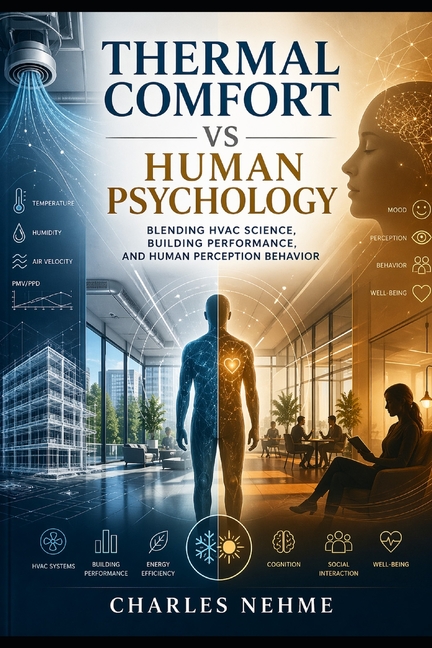
Thermal Comfort vs Human Psychology: Blending HVAC science, building performance, and human percepti
$30.23
Payment received
We are registering your order now. Please stay on this page while we redirect you to the confirmation page.
- In Stock - Ship in 24 hours with Free Online tracking.
- FREE DELIVERY by Tuesday, April 28, 2026
- Secure checkout
- 15-day returns
- 24/24 Online
- Yes High Speed
- Yes Protection
Description
Thermal comfort is often treated as a simple engineering outcome-set a temperature, control humidity, adjust airflow, and assume occupants will be satisfied. Yet, real-world experience consistently proves otherwise.
Two people can sit in the same room, under identical environmental conditions, and report completely different levels of comfort. One feels "too cold," the other "perfect," and a third may feel "stuffy" despite ideal readings on a sensor dashboard.
This gap between measured conditions and human perception is where engineering meets psychology.
This book explores that gap.
It examines how thermal comfort is not only a physical state defined by heat transfer, air movement, and humidity, but also a deeply psychological experience influenced by expectation, adaptation, culture, control, and emotional state. In modern HVAC design, ignoring the human factor leads to systems that perform well on paper but fail in practice.
As buildings become more energy-efficient and tightly controlled, discomfort complaints paradoxically increase. Why? Because comfort is no longer just about physics-it is about perception.
This book aims to bridge that divide by combining HVAC fundamentals, environmental physics, and human behavioral science into a unified understanding of comfort. It is written for engineers, designers, and decision-makers who want to move beyond conventional setpoint thinking and toward truly human-centered environmental design.
Product Details
- Apr 21, 2026 Pub Date:
- 9798258299512 ISBN-10:
- 9798258299512 ISBN-13:
- English Language
Fast moving this week
 Chainsaw Man Box Set
$93.87
Chainsaw Man Box Set
$93.87
 National Geographic Atlas of the World, 11th Edition
$183.40
National Geographic Atlas of the World, 11th Edition
$183.40
 Invincible Compendium Volume 2
$51.64
Invincible Compendium Volume 2
$51.64
 Naruto Box Set 2: Volumes 28-48 with Premium
$128.57
Naruto Box Set 2: Volumes 28-48 with Premium
$128.57
 Diary: Divine Mercy in My Soul (Revised)
$11.61
Diary: Divine Mercy in My Soul (Revised)
$11.61
 Netter's Anatomy Flash Cards
$41.84
Netter's Anatomy Flash Cards
$41.84
 It's Not You: Identifying and Healing from Narcissistic People
$18.57
It's Not You: Identifying and Healing from Narcissistic People
$18.57
 Amygdala
$49.86
Amygdala
$49.86
 Mom, I Want to Hear Your Story: A Mother's Guided Journal To Share Her Life & Her Love
$13.71
Mom, I Want to Hear Your Story: A Mother's Guided Journal To Share Her Life & Her Love
$13.71

Money Back
Love it! Use it! Reuse it!

Free Shipping
Shipping is on us

Free Support
24/24 available