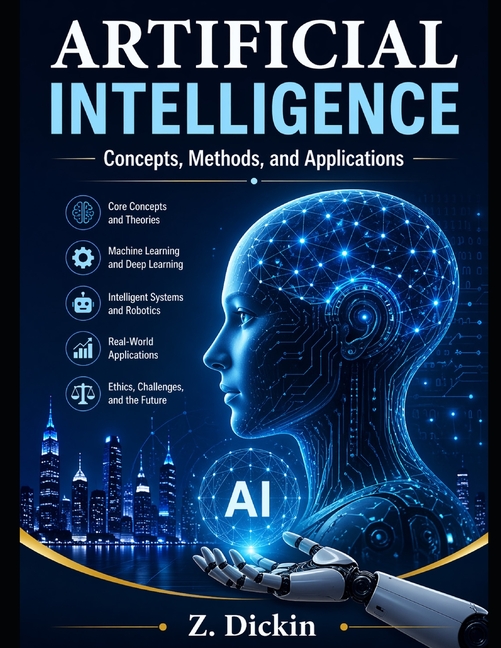
click to view more
Artificial Intelligence: Concepts, Methods, and Applications
by Dickin, Z
$16.05
List Price: $20.00
Save: $3.95 (19%)
Fast checkout
Pay with Apple Pay or Google Pay when available.
Payment received
We are registering your order now. Please stay on this page while we redirect you to the confirmation page.
- In Stock - Ship in 24 hours with Free Online tracking.
- FREE DELIVERY by Tuesday, April 28, 2026
- Secure checkout
- 15-day returns
- 24/24 Online
- Yes High Speed
- Yes Protection
Description
Artificial Intelligence (AI) has rapidly transformed from a theoretical concept into one of the most influential technologies shaping the modern world. From healthcare diagnostics and financial forecasting to autonomous vehicles and intelligent virtual assistants, AI has become deeply integrated into daily life and global industries. This book, Artificial Intelligence: Concepts, Methods, and Applications, is written to provide readers with a comprehensive and accessible understanding of the principles, techniques, and real-world uses of AI.
The origins of artificial intelligence can be traced back to the mid-20th century, particularly to the historic Dartmouth Conference where the term "Artificial Intelligence" was formally introduced by John McCarthy and fellow researchers. Since then, AI has evolved through multiple phases-from early symbolic reasoning systems to modern machine learning and deep neural networks capable of learning from massive datasets.
This book is designed to guide readers through the journey of AI, beginning with its foundational concepts and historical development, and progressing toward advanced techniques such as machine learning, neural networks, natural language processing, computer vision, robotics, and ethical considerations in AI deployment. Each chapter has been structured to build upon the previous one, enabling readers to gradually develop both theoretical knowledge and practical insight.
The primary objectives of this book are:
In recent years, advances in technologies such as Machine Learning, Deep Learning, Natural Language Processing, and Computer Vision have accelerated the growth of AI applications. These developments have enabled machines to recognize speech, interpret images, translate languages, and even generate creative content.
This book has been written with students, educators, researchers, and technology enthusiasts in mind. It aims to provide clear explanations, structured discussions, and relevant examples to support both academic learning and professional development. Whether the reader is new to artificial intelligence or seeking a deeper understanding of its mechanisms and impact, the chapters in this book offer a valuable resource.
The origins of artificial intelligence can be traced back to the mid-20th century, particularly to the historic Dartmouth Conference where the term "Artificial Intelligence" was formally introduced by John McCarthy and fellow researchers. Since then, AI has evolved through multiple phases-from early symbolic reasoning systems to modern machine learning and deep neural networks capable of learning from massive datasets.
This book is designed to guide readers through the journey of AI, beginning with its foundational concepts and historical development, and progressing toward advanced techniques such as machine learning, neural networks, natural language processing, computer vision, robotics, and ethical considerations in AI deployment. Each chapter has been structured to build upon the previous one, enabling readers to gradually develop both theoretical knowledge and practical insight.
The primary objectives of this book are:
- To explain the fundamental principles of artificial intelligence.
Understanding the core ideas behind AI-including algorithms, data, learning models, and decision-making processes-is essential for appreciating its capabilities and limitations. - To introduce key AI technologies and methodologies.
Topics such as machine learning, deep learning, expert systems, and intelligent agents are discussed in a systematic and approachable manner. - To explore real-world applications of AI across industries.
AI is revolutionizing sectors such as healthcare, education, finance, agriculture, manufacturing, and transportation. Examples throughout the book illustrate how intelligent systems are solving complex problems. - To discuss ethical, social, and future implications of AI.
As AI systems become more powerful, questions about fairness, transparency, privacy, and responsibility have become increasingly important. Addressing these issues is crucial for the responsible development of AI technologies.
In recent years, advances in technologies such as Machine Learning, Deep Learning, Natural Language Processing, and Computer Vision have accelerated the growth of AI applications. These developments have enabled machines to recognize speech, interpret images, translate languages, and even generate creative content.
This book has been written with students, educators, researchers, and technology enthusiasts in mind. It aims to provide clear explanations, structured discussions, and relevant examples to support both academic learning and professional development. Whether the reader is new to artificial intelligence or seeking a deeper understanding of its mechanisms and impact, the chapters in this book offer a valuable resource.
Last updated on
Product Details
- Apr 21, 2026 Pub Date:
- 9798258314987 ISBN-10:
- 9798258314987 ISBN-13:
- English Language
Buyer favorite
Fast moving this week
 Chainsaw Man Box Set
$93.87
Chainsaw Man Box Set
$93.87
 National Geographic Atlas of the World, 11th Edition
$183.40
National Geographic Atlas of the World, 11th Edition
$183.40
 Invincible Compendium Volume 2
$51.64
Invincible Compendium Volume 2
$51.64
 Naruto Box Set 2: Volumes 28-48 with Premium
$128.57
Naruto Box Set 2: Volumes 28-48 with Premium
$128.57
 Diary: Divine Mercy in My Soul (Revised)
$11.61
Diary: Divine Mercy in My Soul (Revised)
$11.61
 Netter's Anatomy Flash Cards
$41.84
Netter's Anatomy Flash Cards
$41.84
 It's Not You: Identifying and Healing from Narcissistic People
$18.57
It's Not You: Identifying and Healing from Narcissistic People
$18.57
 Amygdala
$49.86
Amygdala
$49.86
 Mom, I Want to Hear Your Story: A Mother's Guided Journal To Share Her Life & Her Love
$13.71
Mom, I Want to Hear Your Story: A Mother's Guided Journal To Share Her Life & Her Love
$13.71

Money Back
Love it! Use it! Reuse it!

Free Shipping
Shipping is on us

Free Support
24/24 available